
Kenya is headed towards yet another election in 2027, and the campaigns have already started.
As the political scene gets hotter by the day, the Stats Kenya team is gearing up its polls, bringing clarity where there’s currently none. In this article, therefore, we release the results of our opinion poll conducted between the second and the fourth weeks of March 2026.
If Elections Were Held Today, Who Would You Vote For?
- 23.4% of our respondents would vote for William Ruto.
- 12.3% would vote for Fred Matiang’i.
- 8.2% would vote for Kalonzo Musyoka.
- 7.4% would vote for Edwin Sifuna.
- 4% would vote for Rigathi Gachagua.
- 1.5% would vote for David Maraga.
- 1% would vote for Oburu Odinga.
- 0.4% would vote for Okiya Omtata
- 29% of our respondents were still undecided by the time of the survey.
- 7.4% refused to say who they’d vote for.
- 5.6% would either not vote or would not vote for any of the candidates listed.

What are Prediction Markets Saying?
We are also following up on the Kenyan Prediction Market 5050 Markets to benchmark our polls and get closer to the truth.
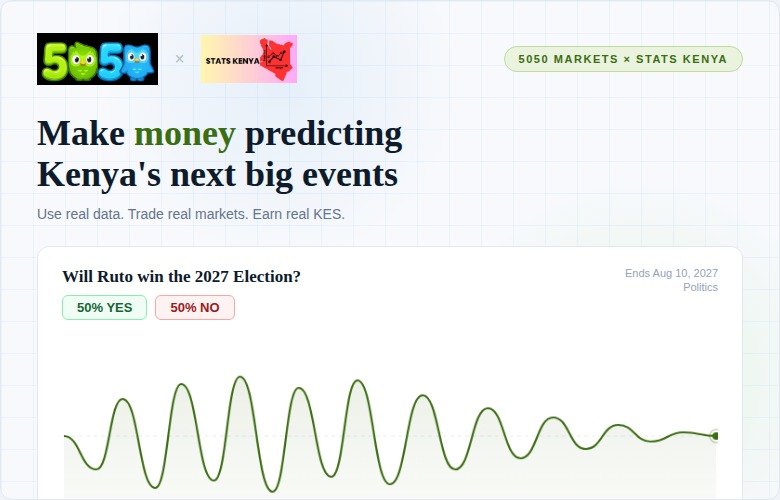
According to 5050 Markets, President Ruto currently has a 71% chance of winning the coming elections.
Prediction markets tend to be more accurate than traditional polls, since the financial stake pushes traders to be more rational. However, we expect these markets to get tighter as more Kenyans discover prediction markets and participate in them.

There’s Still a Large Number of Kenyan Adults Who Haven’t Registered to Vote
Voter registration will influence key outcomes in the 2027 election. The Niko Kadi movement is one of the ongoing initiatives that seeks to increase voter registration among the youth.
The IEBC is also on a campaign to increase voter registration through its Enhanced Continuous Voter Registration (ECVR).
The results of our survey reveal the acute need to register more people, as only 57.4% of our respondents were registered voters.
The number of unregistered voters was quite high, accounting for 36.9% of the respondents.

Will the 2027 Kenya General Election be Free and Fair?
Slightly less than half of our respondents (46.1%) believed the coming election would be free and fair.
On the other hand, more than a quarter of the respondents (28.9%) believed the election would not be free and fair.

Institutional trust in the elections and in the IEBC is essential if we are to run a successful electioneering period. Without trust, emotions run high, and the chances of violence increase significantly.
It is, therefore, worth asking, what is the IEBC doing to assure Kenyans that the elections will be free and fair?
President Ruto’s Approval Rating Remains Low
In 2022, President William Ruto won the elections, having garnered 50.49% of the vote.
With a year to the elections, our survey currently shows that only 32% of respondents approve of the president, with 34% of our respondents disapproving of him.

Methodological Highlights
Our survey targeted all Kenyan adults of voting age, whether or not they were registered to vote.
A simple program was developed to randomly generate phone numbers, ensuring that each Safaricom phone number (identified from the prefix) in existence had an equal and independent probability of being selected for the survey.
With Safaricom being the dominant telco with more than 50 million customers, this technique ensured that every adult was within reach. Any children who picked up calls were directed to hand over the phone to their parents or were otherwise dropped.
Other key details of the survey include:
|
Sample size |
1,102 |
|
Margin of Error |
2.95% [95 CI, p = 0.5] |
|
Data Collection Method |
Telephonic Survey |
|
Data Collection Process |
Expert Personnel Administering Mobile Telephone Interviews Via CATI |
|
Date of Survey |
9th March – 29th March |
|
Time of Survey |
9:30 AM – 6 PM |
|
Questionnaire Type |
Structured |
|
Data Collection Tool |
KOBO |
|
Data Cleaning and Validation |
R Studio |
|
Data Analysis |
R Studio |
|
Data Visualization |
R Studio |
|
Sponsor |
Detam Stats Kenya LTD |